Wistron and Wiwynn Show NVIDIA Rubin AI Systems at OCP Summit
Oct 12, 2026
Data Centers
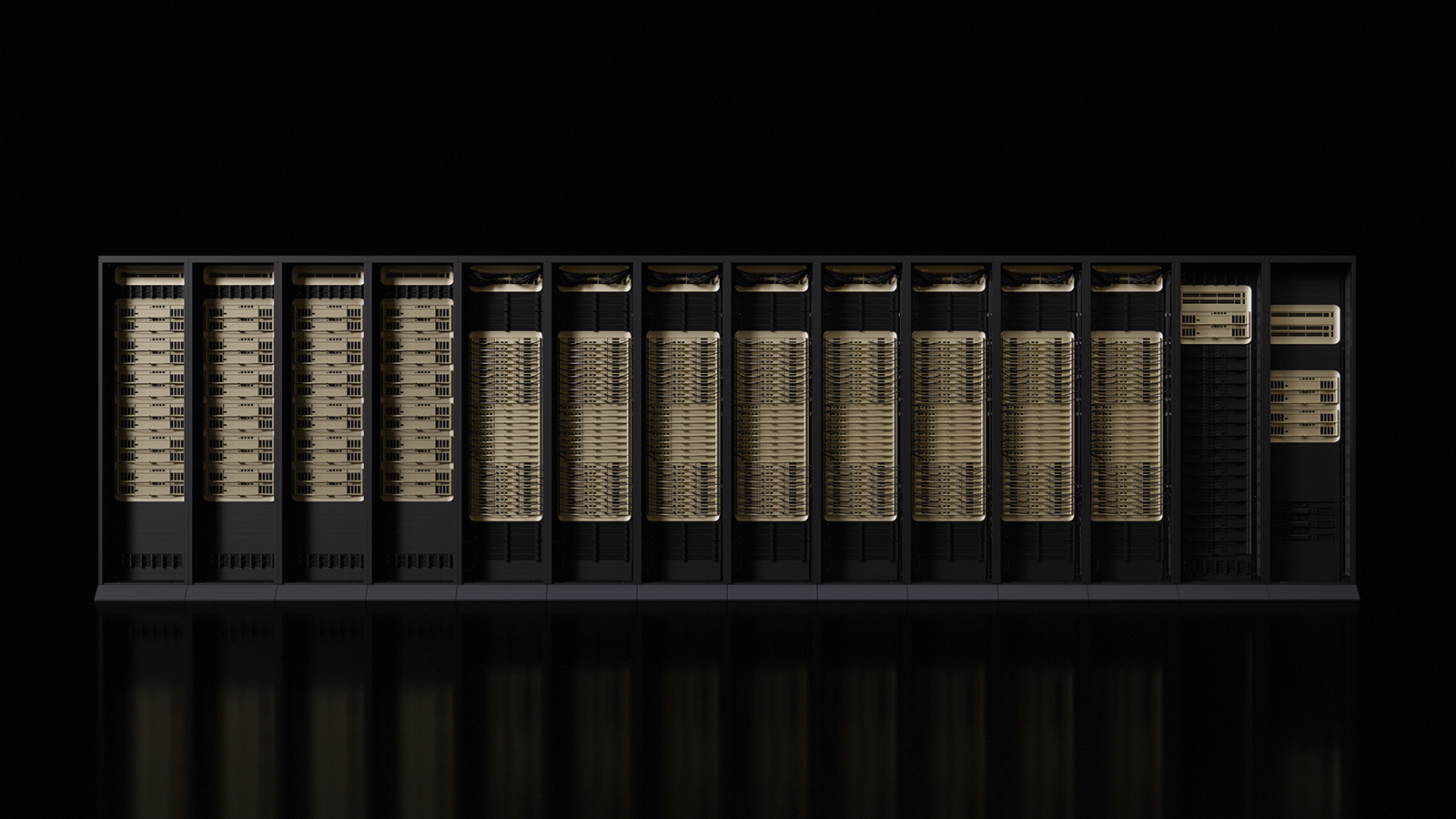
At the Consumer Electronics Show 2026, Nvidia CEO Jensen Huang announced the launch of the company’s Rubin architecture, a new six-chip platform designed to accelerate large-scale AI workloads. The Rubin platform includes the Vera CPU, Rubin GPU, NVLink 6 switch, ConnectX-9 SuperNIC, BlueField-4 DPU, and Spectrum-6 Ethernet switch, built through a process Nvidia calls “extreme codesign.”
The new architecture delivers up to ten times lower inference token cost and requires four times fewer GPUs to train mixture-of-experts models compared with the previous Blackwell generation. It introduces the Inference Context Memory Storage Platform, powered by BlueField-4, to handle the memory demands of agentic AI and long-context reasoning. The Rubin GPU offers up to 50 petaflops of inference compute, while Spectrum-X Ethernet photonics systems provide five times greater power efficiency and uptime.
The Rubin platform will be used in large-scale AI systems including Microsoft’s Fairwater AI superfactories and HPE’s Blue Lion supercomputer. Cloud providers such as AWS, Google Cloud, Microsoft, and Oracle Cloud Infrastructure plan to deploy Rubin-based instances beginning in the second half of 2026. AI companies including Anthropic, OpenAI, Meta, and xAI are also expected to adopt Rubin for training and inference workloads.
Nvidia stated that Rubin systems are now in full production, marking the company’s next major step in its annual hardware development cycle. The platform succeeds the Blackwell architecture and is designed to support the increasing computational demands of advanced AI models and data center-scale deployments.
Consider subscribing to one of our newsletters like Silicon Brief or Daily AI Brief.
Also, consider following us on social media:
Weekly coverage of AI hardware developments including chips, GPUs, cloud platforms, and data center technology.


 Tensordyne
This Tensordyne whitepaper presents Napier, an inference-focused AI processor and rack-scale system based on the company’s TDN Math logarithmic number system. It examines infrastructure requirements for large mixture-of-experts and agentic models, compares major inference architecture approaches, and details the TDN AIP processor, TDN72 pod, TDN Link fabric, and Napier Ultra configuration. The paper reports simulation-based performance, cost, and accuracy-validation results, including Tensordyne’s projected comparison of one Napier rack with a nine-rack Nvidia Rubin plus Groq deployment; the chip is reported as taped out and in fabrication.
Read moreDaily AI Brief: the AI news that matters, in your inbox.